

Most GCC organizations have invested heavily in perimeter security: firewalls, EDR tools, SIEM platforms, and MFA rollouts. The perimeter is reasonably well defended. But one control consistently gets overlooked, and it sits on every endpoint in the fleet, quietly expanding the blast radius of almost every attack that gets through. That control is local administrator rights.
In most enterprise environments across the region, a large number of endpoints run with permanent local admin access. Not because anyone made a deliberate decision to accept the risk, but because granting it was faster than not granting it. A user needed to install software, IT was stretched, and the shortcut became the standard.
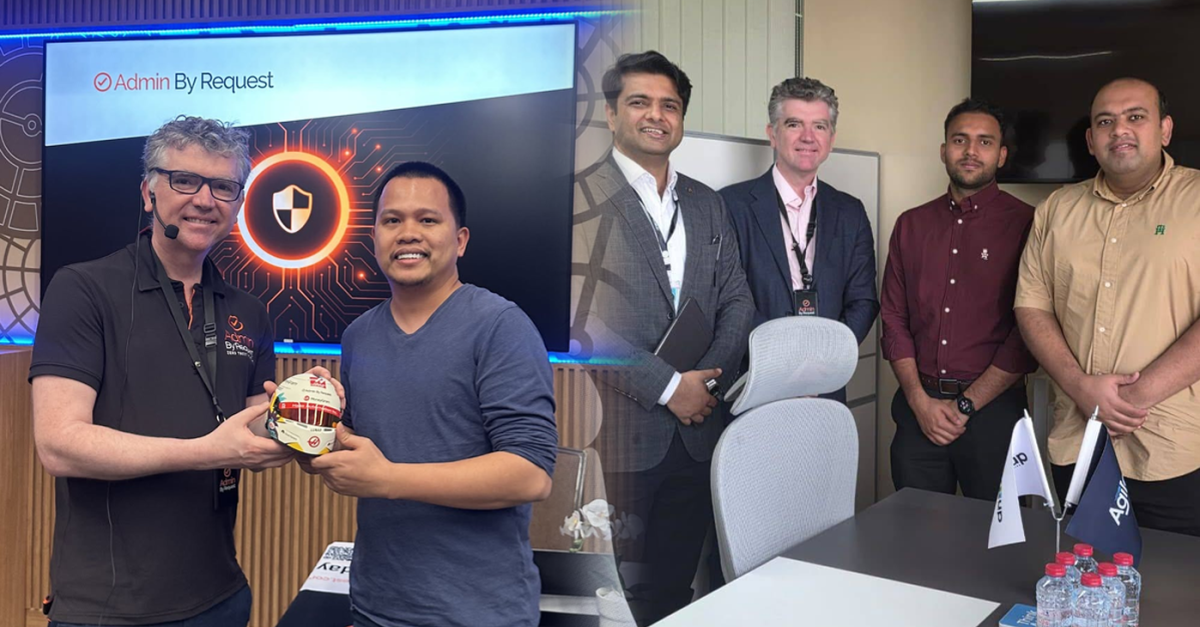
That shortcut is now one of the most consistently exploited conditions in enterprise breach investigations. Removing it, without slowing people down, is where Endpoint Privilege Management comes in. Across the GCC, that’s the work Agile ManageX Technologies does as the authorized exclusive distributor of Admin By Request for the region.
Why Are Permanent Local Administrator Rights Still a Security Risk?
When a user operates with local administrator rights, any malware that reaches their endpoint inherits those privileges immediately. Ransomware can encrypt files, spread laterally, and disable security tooling without needing to escalate anything first.
This is one of the main reasons organizations are moving toward Endpoint Privilege Management (EPM). Verizon’s Data Breach Investigations Report continues to rank credential abuse and privilege misuse among the most common breach techniques, which is no surprise: standing admin rights make endpoints the easiest pivot point once an attacker clears the perimeter.
The insider risk is just as real. An employee with permanent admin access can install unauthorized software or change system configurations in ways that create compliance gaps, often invisible in standard audit logs until something goes wrong.
Compliance frameworks are hardening around this too. ISO 27001, PCI DSS, NIST, and sector-specific regulations increasingly require demonstrable, auditable least-privilege controls at the endpoint level, not just policy documents. For GCC organizations operating under national cybersecurity frameworks, the direction is clear.
Why Traditional PAM Doesn’t Cover This
Privileged Access Management handles the infrastructure layer well. Credential vaulting, server access control, and privileged session monitoring are legitimate capabilities that belong in any mature security program.
Where traditional PAM tends to stop short is the individual endpoint, at the user level, in real time. Its workflows are built around privileged accounts and server access, so standing local admin rights on everyday user machines often sit outside its reach. That’s the same exposure the rest of this article keeps coming back to: an endpoint with permanent admin rights is a bigger blast radius the moment anything goes wrong on it, and credential vaulting doesn’t change that.
Endpoint Privilege Management addresses that layer directly. It removes standing admin rights while giving users a structured, audited way to elevate specific applications for a set period. Routine requests move quickly without IT involvement, higher-risk actions go through an approval workflow, and everything is logged.
This is why the two are increasingly used together. Some PAM platforms now include endpoint privilege controls, but where that layer is missing, organizations with otherwise strong PAM programs still carry real exposure at the endpoint.
Why Are GCC Enterprises Prioritizing Endpoint Privilege Management Now?
Several pressures have converged to make endpoint privilege management a live priority rather than a roadmap item across the region:
- Zero Trust adoption is moving from strategy to implementation, and its core requirement (minimum necessary access, verified at each step) can’t be satisfied while endpoints carry permanent admin rights. Microsoft’s Digital Defense Report points to identity-based attacks as a dominant and growing vector, the kind of exposure that standing admin rights make worse.
- AI-assisted attacks are shrinking the exploitation window, with threat actors using automation to scan for exposed endpoints and move laterally faster than security teams can respond. A machine with standing admin rights in that environment is a live risk, not a theoretical one.
- Hybrid and remote work has changed the endpoint picture permanently. Security teams no longer have physical proximity to the devices they manage, so controls on remote endpoints need to stand on their own.
- Digital transformation keeps expanding the attack surface: more devices, more contractors, more third-party software, and often more local admin rights quietly granted to keep pace. IBM’s Cost of a Data Breach Report puts the global average breach at millions of dollars, with slow detection and containment among the biggest cost drivers.
- Regulatory expectations are tightening as well, with assessments across financial services, healthcare, and government increasingly demanding automated, auditable proof of least-privilege controls.
Common Areas Where Endpoint Privilege Risks Show Up
Across enterprise environments, the same areas tend to produce the most significant privilege-related findings.
Endpoints where patching is inconsistent carry software vulnerabilities that are publicly documented and actively exploited. Local admin rights mean exploitation requires no additional escalation once an attacker reaches the machine.
Third-party and contractor access is one of the most overlooked privilege risks. Vendors granted elevated access for a project six months ago often still have it. Nobody flagged it for review, and nobody removed it.
Remote and hybrid endpoints operating outside the corporate network are harder to manage consistently. A device working from home, with local admin rights and personal-use patterns, is a materially different risk from the same device inside a managed environment.
How Does Our EPM Solution Reduce Endpoint Privilege Risks?
Admin By Request’s Endpoint Privilege Management product removes standing administrator rights and replaces them with controlled, time-limited elevation built around how people actually work, rather than an idealized security model that creates friction and gets worked around.
Just-in-Time privilege elevation lets users request temporary elevation for a specific task. The request is logged, elevation is granted, the task completes, and the privilege is revoked automatically. No standing access, no residual risk, and no IT ticket for routine requests.
Run As Admin allows individual applications to run with elevated rights without elevating the entire user session. If an attacker reaches that endpoint mid-session, they inherit standard user rights, not admin rights, because elevation is scoped to a single process. The blast radius stays contained.
Before elevation is approved, the application is checked through cloud-based malware reputation scanning across multiple antivirus engines, cutting the risk of users unintentionally running compromised software with elevated rights. For compliance teams, the audit trail is often the most valuable output: every elevation, approval, and denial logged by named user, machine, and timestamp, turning regulatory reviews into a report instead of a manual reconstruction. Coverage extends across Windows, macOS, and Linux within a single management framework, which matters for mixed endpoint environments.
Who Are Agile ManageX Technologies, and Why Partner With Them in the GCC?
Agile ManageX Technologies is a Dubai-based IT and cybersecurity firm that has worked in the region for over a decade. Their services span cybersecurity resilience, IT infrastructure management, and digital transformation, so clients can run Endpoint Privilege Management as part of a broader security program handled by one partner.
They are also the authorized exclusive distributor of Admin By Request across the GCC, running the local relationship from first conversation through deployment and support. That means a team in the same time zone, speaking the same business language, familiar with regional compliance and the way organizations in the area operate. Specifically:
- Local expertise and support, with responsive, in-region help and a working understanding of local business requirements
- Implementation and onboarding, with hands-on deployment, configuration, PoC support, and integration, rather than leaving IT teams to handle rollout alone
- Faster procurement, with local invoicing, contracting, and purchasing for organizations that prefer working with a regional entity
- A broader partner ecosystem, with access to certified local specialists for implementation, managed services, training, and ongoing support
- Commercial flexibility, with licensing, renewals, and project scope structured around each organization’s requirements rather than a fixed global template
- A single point of coordination, so clients manage one relationship for both the product and its implementation, instead of coordinating separately between a vendor and a third-party integrator
Which Industries Benefit Most From Endpoint Privilege Management?
Financial services face the most specific regulatory requirements. Least privilege at the endpoint is increasingly a named control in compliance assessments, not a general recommendation.
Healthcare needs clinical teams to move quickly without weakening access controls over systems handling patient records. Just-in-Time elevation handles both without the trade-off.
Government and public sector organizations face formal cybersecurity maturity assessments where documented endpoint controls are evaluated directly. Energy and critical infrastructure environments mix IT and OT networks in ways where a compromised endpoint can have consequences well beyond data loss. Education manages large, dispersed endpoint fleets with limited IT resources per device: the same helpdesk bottleneck as enterprise, at much higher volume.
Endpoint Privilege Management and Zero Trust
Zero Trust is built on the principle of least privilege, and Endpoint Privilege Management makes that principle practical by removing permanent administrator rights and granting temporary access only when needed.
As organizations across the GCC strengthen their security strategies, EPM has become a business necessity rather than an optional control. Admin By Request’s EPM solution makes Just-in-Time privilege elevation practical, with full audit visibility across every request.
Ready to remove permanent administrator rights? Start with 25 free endpoints, or if you’re in the GCC, get in touch with Agile ManageX Technologies to arrange an endpoint privilege assessment or a demo.
Frequently Asked Questions
What is Endpoint Privilege Management?
Endpoint Privilege Management (EPM) removes permanent local administrator rights and replaces them with controlled, time-limited privilege elevation. Users receive administrative access only when needed, helping organizations reduce security risks, enforce least privilege, and maintain full audit visibility.
How is Endpoint Privilege Management different from PAM?
Privileged Access Management (PAM) secures privileged accounts, servers, and infrastructure, while Endpoint Privilege Management (EPM) controls administrative access on individual user devices. Together they cover privilege security across both infrastructure and endpoints.
Why are local administrator rights considered a security risk?
Permanent local administrator rights give malware and attackers elevated privileges immediately after a device is compromised. This increases the risk of ransomware, unauthorized software installation, lateral movement, and compliance failures.
How does Endpoint Privilege Management support Zero Trust?
EPM supports Zero Trust by removing standing administrator rights, granting access only when required, and logging every privileged action. This enforces the principle of least privilege while reducing the attack surface across enterprise endpoints.
What is Just-in-Time privilege elevation?
Just-in-Time (JIT) privilege elevation provides temporary administrator access for a specific application or task. Once the task is complete, elevated privileges are removed automatically, reducing security risks without affecting user productivity.
Why are GCC organizations prioritizing Endpoint Privilege Management now?
Growing Zero Trust adoption, stricter compliance requirements, hybrid work, and increasing ransomware activity are driving GCC organizations to strengthen endpoint security. EPM helps reduce cyber risk while improving operational efficiency and audit readiness.
Can Endpoint Privilege Management improve compliance?
Yes. EPM creates an automated audit trail for every privilege request, approval, and elevation, helping organizations demonstrate compliance with standards such as ISO 27001, PCI DSS, NIST, and regional cybersecurity frameworks.
How does Admin By Request handle cross-platform environments?
Admin By Request’s EPM solution supports Windows, macOS, and Linux through a single management platform. Organizations can apply consistent privilege policies, maintain centralized visibility, and simplify security management across mixed endpoint environments.
How can organizations in the GCC implement Endpoint Privilege Management?
Organizations can adopt Endpoint Privilege Management by deploying Admin By Request’s EPM solution with the support of Agile ManageX Technologies, the authorized distributor across the region. The team assists with planning, deployment, configuration, and ongoing technical support.